
The circuit below is used to heat water kept in a bucket. Assuming heat loss only by Newton's law of cooling, the variation in the temperature of the water in the bucket as a function of time is depicted by
- A
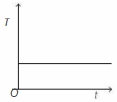
- B
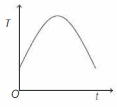
- C
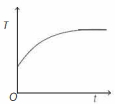
- D
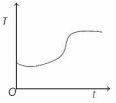
Explore More
Similar Questions
$A$ body cools from $75 \, ^\circ \text{C}$ to $65 \, ^\circ \text{C}$ in $2 \, \text{min}$ in a room at $30 \, ^\circ \text{C}$. How long will it take to cool from $55 \, ^\circ \text{C}$ to $45 \, ^\circ \text{C}$ in the same room?
Difficult
View SolutionAccording to Newton's law of cooling,the rate of cooling of a body is proportional to $(\Delta \theta )^n$,where $\Delta \theta$ is the difference of the temperature of the body and the surroundings,and $n$ is equal to
The temperature of a liquid drops from $365 \ K$ to $361 \ K$ in $2$ minutes. Find the time during which the temperature of the liquid drops from $344 \ K$ to $342 \ K$. The temperature of the room is $293 \ K$.
Difficult
View Solution$A$ sphere,a cube,and a thin circular plate,all of the same material and same mass,are initially heated to the same high temperature and allowed to cool down under similar conditions. Then,the
MediumKCET 2020
View SolutionTwo solid spheres of radii $R_1$ and $R_2$ are made of the same material and have similar surfaces. The spheres are raised to the same temperature and then allowed to cool under identical conditions. Assuming the spheres to be perfect conductors of heat,the ratio of their initial rates of cooling is:
Vedclass Products
For Students
Vedclass Test Series
Mock tests in real JEE/NEET style with performance analysis. 5-day free trial.
Start Free TrialFor Teachers
Exam Paper Generator
Generate Set A/B/C/D exam papers from 7.5L+ questions in 2 minutes. 3 chapters free.
Try FreeFor Institutes
Online Exam Module
Live online exams with unlimited students, 360° analytics & white-label branding.
See Demo